In Guernsey, The Era of Wet-Ink Verification is Ending
Danny Dean
June 3, 2026
•
5
min read
In Guernsey, The Era of Wet-Ink Verification is Ending
The GFSC's May 2026 Handbook update redraws the line on what good CDD looks like.
The Guernsey Financial Services Commission has been updating its AML/CFT/CPF Handbook at regular intervals as part of its commitment to aligning with Financial Action Task Force standards. The May 2026 update, published on 5 May and subsequently corrected on 8 May to include revised chapters 7, 9, 10, 16 and Appendix F, is the latest in that sequence. It arrives as Guernsey continues to operate under scrutiny from international bodies assessing the Bailiwick’s financial crime framework.
The GFSC's updates to its AML/CFT/CPF Handbook, issued earlier this May, are not a seismic shift in obligation, they are a clear articulation of where the regulatory horizon is heading.
Digital verification in Guernsey moves to centre stage
The most substantive changes concern electronic certification and electronically verified identification, now explicitly aligned with the Electronic Transactions (Bailiwick of Guernsey) Law, 2000. While electronic certification remains a choice rather than a requirement, the GFSC leaves little doubt that it belongs within a well-governed, risk-based CDD framework.
• Electronic certification is now explicitly aligned with the Electronic Transactions (Bailiwick of Guernsey) Law, 2000, formalising its place within a risk-based CDD framework.
• Electronically verified identification is recognised as a valid method of CDD, not a workaround.
• Firms continuing to rely on wet-ink certified documents must now justify that choice within their risk framework, rather than treating it as the default.
For firms still operating primarily on wet-ink certified documents, this is worth noting. The regulatory framework has evolved, and reliance on legacy processes now demands a more deliberate justification. Firms whose onboarding frameworks haven't been reviewed in light of these changes may find themselves out of step with regulatory expectations.
The Electronic Transactions (Bailiwick of Guernsey) Law, 2000 provides the legal foundation for treating electronic signatures and electronically authenticated documents as equivalent to their paper counterparts. Its explicit incorporation into the Handbook’s CDD framework is significant: it removes any residual ambiguity about whether electronic verification satisfies Guernsey’s legal standard. Firms that have been treating digital identity checks as a convenient alternative to the “real” process should recalibrate. Electronically verified identification is not a workaround. It is now expressly part of the framework.
Technology risk as a compliance discipline
The updates also formalise technology risk assessment as a substantive compliance consideration in its own right. Technology used in compliance is no longer judged on whether it works. The question now is whether firms can show they understand it, have stress-tested it, and have kept human governance at its core.
• Can they demonstrate a documented understanding of how their compliance technology operates?
• Have they stress-tested it against failure scenarios?
• Is human oversight formally embedded in their governance structure?
Broader awareness of distributed ledger technology and Virtual Asset Service Provider risk factors also features in the revised Handbook. Neither creates prescriptive new obligations, but both signal that firms should be thinking about this exposure proactively, not reactively.
For firms with exposure to virtual assets or clients who use them, the Handbook’s inclusion of DLT and VASP risk factors reflects FATF Recommendation 15, which requires jurisdictions to apply AML/CFT measures to virtual asset activity. The GFSC’s framing is deliberately non-prescriptive: it is not mandating new controls, but it is signalling that supervisors will expect firms to have considered their exposure and documented their rationale. A firm that cannot articulate its VASP risk position is, in effect, not in a defensible position.
What the GFSC’s May 2026 Update Means for Your Firm
The GFSC has not sounded an alarm. It has updated a map. The direction of travel is clear: in Guernsey, digital verification is no longer the exception, it is the expectation. Firms that read these changes carefully, and act on them, will be better placed for what comes next.
What to review now
Firms that want to act on these changes rather than wait for a supervisory prompt should focus on three areas.
• Your CDD framework: Does it explicitly accommodate electronic verification? If onboarding relies on wet-ink certified documents as the default, that default now needs a documented justification.
• Your technology governance: For any compliance technology in use, can you demonstrate documented understanding, stress-testing records, and clear human oversight? These are the three questions the updated Handbook implicitly poses.
• Your VASP and DLT exposure assessment: If your firm has client relationships that touch virtual assets, is your risk rationale current and written down? Silence is not a position.
That is precisely what Verify by Tiller is built for. Our platform gives firms the governance, audit trail, and electronic verification infrastructure to meet these expectations with confidence.
FAQs:
What did the GFSC update in its May 2026 AML/CFT/CPF Handbook? The GFSC updated its Handbook on Countering Financial Crime to formalise electronic certification and electronically verified identification within the CDD framework, introduce technology risk assessment as a substantive compliance requirement, and expand guidance on DLT and Virtual Asset Service Provider risk factors.
Is electronic verification now mandatory for CDD in Guernsey? Not mandatory, but the updated Handbook makes clear it belongs within a well-governed, risk-based CDD framework. Firms continuing to rely on wet-ink certified documents must now actively justify that choice rather than treating it as the default.
What does the GFSC now expect from firms using compliance technology? Firms must be able to demonstrate that they understand how their compliance technology operates, have stress-tested it against failure scenarios, and have human oversight formally embedded in their governance structure.
Do the May 2026 Handbook changes create new obligations for firms with VASP exposure? No new prescriptive obligations, but the Handbook signals that firms should have a documented, proactive position on their DLT and VASP risk exposure. An undocumented risk rationale is not a defensible position under the updated framework.
Join our newsletter to stay up to date on features and releases.
Finance
5
min read
IOM Today features Verify by Tiller’s Companies House event
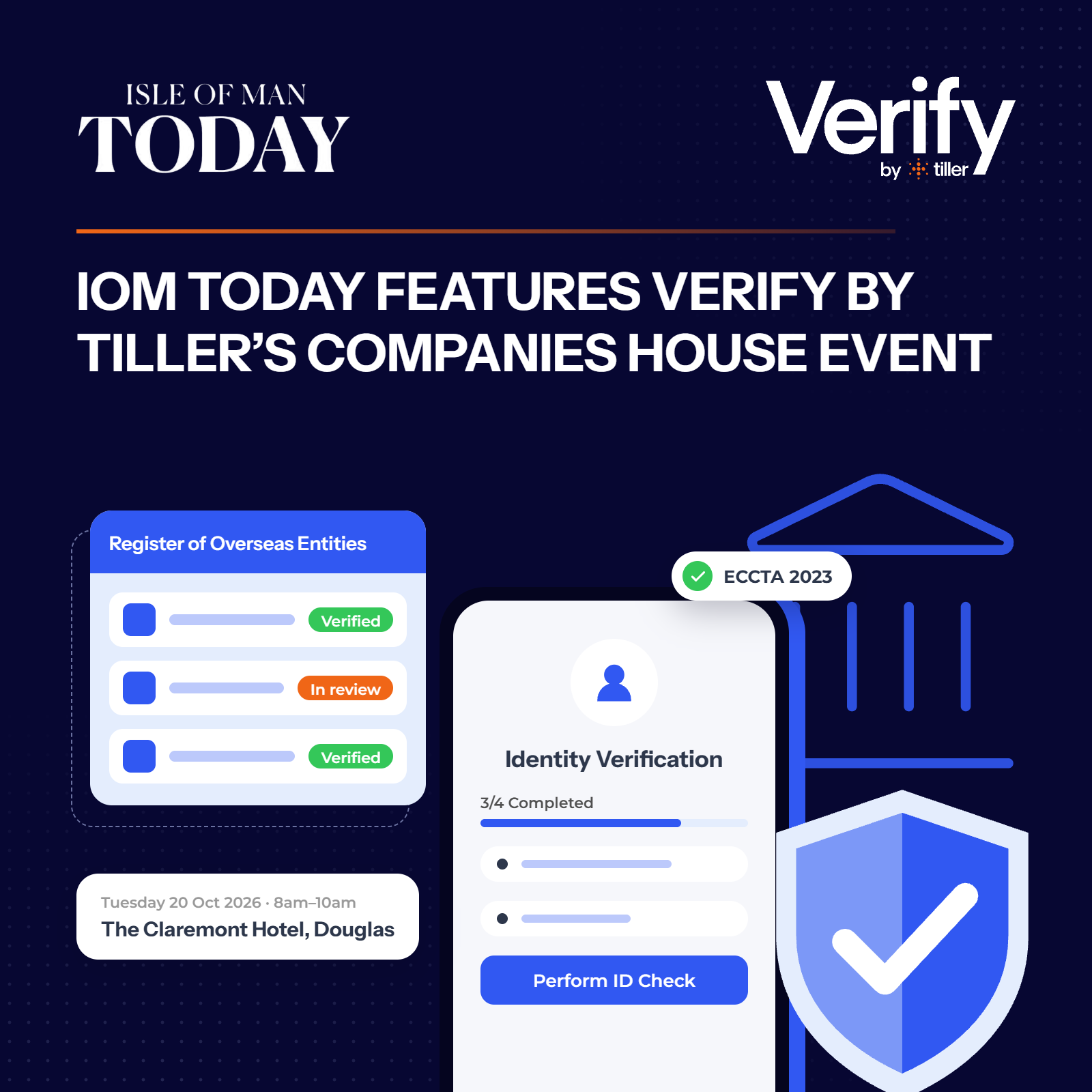
Isle of Man Today covers our upcoming event in Douglas on 20 October, where Liz Kinsey of CRO Corporate Services will explain how the new UK Companies House rules affect offshore businesses. Hosted by our Chief Revenue Officer, Julia Cowan, it’s a practical session on what firms must do to stay compliant.
Verify by Tiller Wins Innovation in Compliance Award at The Jersey Compliance Awards 2026: Jonathan Ripper Recognised for KYC and AML Platform Leadership
Jonathan Ripper of Verify by Tiller wins Innovation in Compliance at Jersey Compliance Awards 2026, recognised for KYC, KYB and AML platform leadership.
New Government Guidance on Digital ID for AML Checks
HM Treasury and DSIT have confirmed certified digital ID as a valid route to AML compliance under MLR 2017. What the new guidance means for regulated firms.





.png)